Unlock Uplifting Headspace on a Forgotten Tuesday
Unlock uplifting headspace on a forgotten Tuesday with simple, practical resets that clear mental fog, restore focus, and create calm in minutes. Help someone find headspace. Share this.


Ten small things that give your brain time back
There’s something quietly heroic about a Tuesday that nobody remembers. Not the fresh-start optimism of Monday, not the promise of Friday, not even the soft reset of Sunday. Just a plain, ordinary day where your brain is expected to perform like a champion while your mood is running on low battery. This is where Fog of Mind comes in.
I'm an expert through experience in navigating the fog of life. I love what I do, and with that, it's time to find some positive energy.
What Fog of Mind is
Fog of Mind is about helping you find headspace when life feels crowded. It’s not therapy, and it’s not a lecture. It’s a practical, human approach to mental wellbeing built around conversation, reflection, and perspective.
I’m interested in the small moments that change the whole day. The tiny adjustments that give your mind room to breathe again. The kind of stuff that doesn’t require a new life plan, a retreat in the mountains, or a complicated app.
Because most of us are not struggling with a lack of motivation. We’re struggling with a lack of mental space.
So if today is a forgotten Tuesday, let’s make it useful. Let’s unlock uplifting headspace with the simplest tools you already have.
The truth about focus
Focus isn’t always a discipline problem. Often it’s a bandwidth problem.
When your mind is carrying too many open tabs, it starts to lag. Your thoughts get sticky. Small tasks feel heavier than they should. You read the same sentence four times and still don’t take it in. You forget why you walked into the kitchen, then stand there judging yourself like you’ve committed a crime.
You haven’t failed. Your brain is doing what brains do when they’re overloaded.
The aim today is not to become a different person. The aim is to give your mind back a few clean minutes so it can do its job.
Ten small things that give your brain time back
None of these are dramatic. That’s the point.
1) Do a two-minute reset, not a big restart
Set a timer for two minutes. Stand up, stretch, roll your shoulders, unclench your jaw, breathe slowly. Two minutes is short enough that your brain doesn’t argue, but long enough to interrupt the fog.
2) Write the “one next thing”, then make it achievable

When your mind is foggy, “get on with it” is too vague. Your brain needs a clear handle to grab.
Take 30 seconds and write one line:
- What is the next action, not the whole task?
- Can I make it so small I can’t talk myself out of it?
Examples:
- Instead of “Start the report” → “Open the document and title it.”
- Instead of “Sort my life out” → “Write three bullets of what’s worrying me.”
- Instead of “Get fit” → “Put trainers by the door.”
- Instead of “Email the client” → “Write the subject line.”
Then do that single action and stop. Momentum is a better motivator than motivation, and clarity often arrives after you begin.
3) Drink water like it’s a mental health tool
It sounds basic because it is basic, and it works. Dehydration nudges you towards fatigue, irritation, and poor concentration. A glass of water is not a personality change, but it is a signal to your body that you are paying attention.
💡Top Tip - Check your pee. It tells you a lot about how much water you've had. It doens't need to be super clear, but it shouldn't look like orange juice either.
Here's a link to a useful Pee Chart.
4) Clear one surface
Pick a single surface, desk corner, kitchen counter, bedside table, and clear it. Not because mess is morally bad, but because visual noise is still noise. A clean surface is a small piece of control you can borrow.
Trust me, this works!
5) Let daylight hit your eyes
Open a curtain. Step outside for one minute. Stand in the doorway. Daylight helps your brain understand the day, the time, the rhythm. It’s a simple cue that reduces that “stuck indoors in my head” feeling.
Sunlight also gives you a shot of Vitamin D. It's a vital nutrient the body needs, along with calcium, to build bones and keep them healthy. The body can absorb calcium only if it has enough vitamin D. Vitamin D also has many other uses in the body. It supports immune health and helps keep muscles and brain cells working.
6) Take a “scroll break” instead of a break
A lot of breaks aren’t breaks. They are content consumption that leaves your mind more scattered than before.
Try a different kind of pause:
- look out the window for 60 seconds
- make a tea or coffee and drink it without doing anything else
- play one song, no multitasking
A real break gives you back attention, not just distraction. I'll be talking more about attention spans in a later edition of Fog of Mind.
7) Change the room, change the mind
If you can, move. Different chair, different room, different angle. The brain loves context shifts. It’s like giving yourself a fresh page without needing a fresh life.
8) Use the “close the loop” trick
Anything unresolved takes up space. Pick one tiny loose end and finish it fully.
Examples:
- send the email you keep rewriting
- book the appointment
- put the thing back where it belongs
- answer one message properly, not vaguely
Closing one loop reduces background mental static.
9) Give your brain a boundary: start and stop times
If a task can expand forever, it will. Set a short container.
- “I’m doing 20 minutes on this.”
- “I’m outlining, not perfecting.”
- “I’m only doing the first draft.”
Boundaries protect focus. Perfection drains it.
10) Speak to yourself like someone you’re responsible for
The voice in your head matters. If it’s harsh, everything becomes harder.
Try swapping:
- “What’s wrong with me?”
for - “What do I need right now to make this easier?”
Fog lifts faster when you stop fighting yourself.
A forgotten Tuesday reframe
A forgotten Tuesday is not a write-off. It’s an opportunity to practise something that actually lasts: the ability to return to yourself.
Headspace isn’t a reward for finishing everything. Headspace is the condition that helps you finish anything at all.
So if you’re feeling behind, distracted, or a bit foggy, do not add shame on top. Start small. Pick one thing from the list and test it for five minutes. That’s enough to begin.
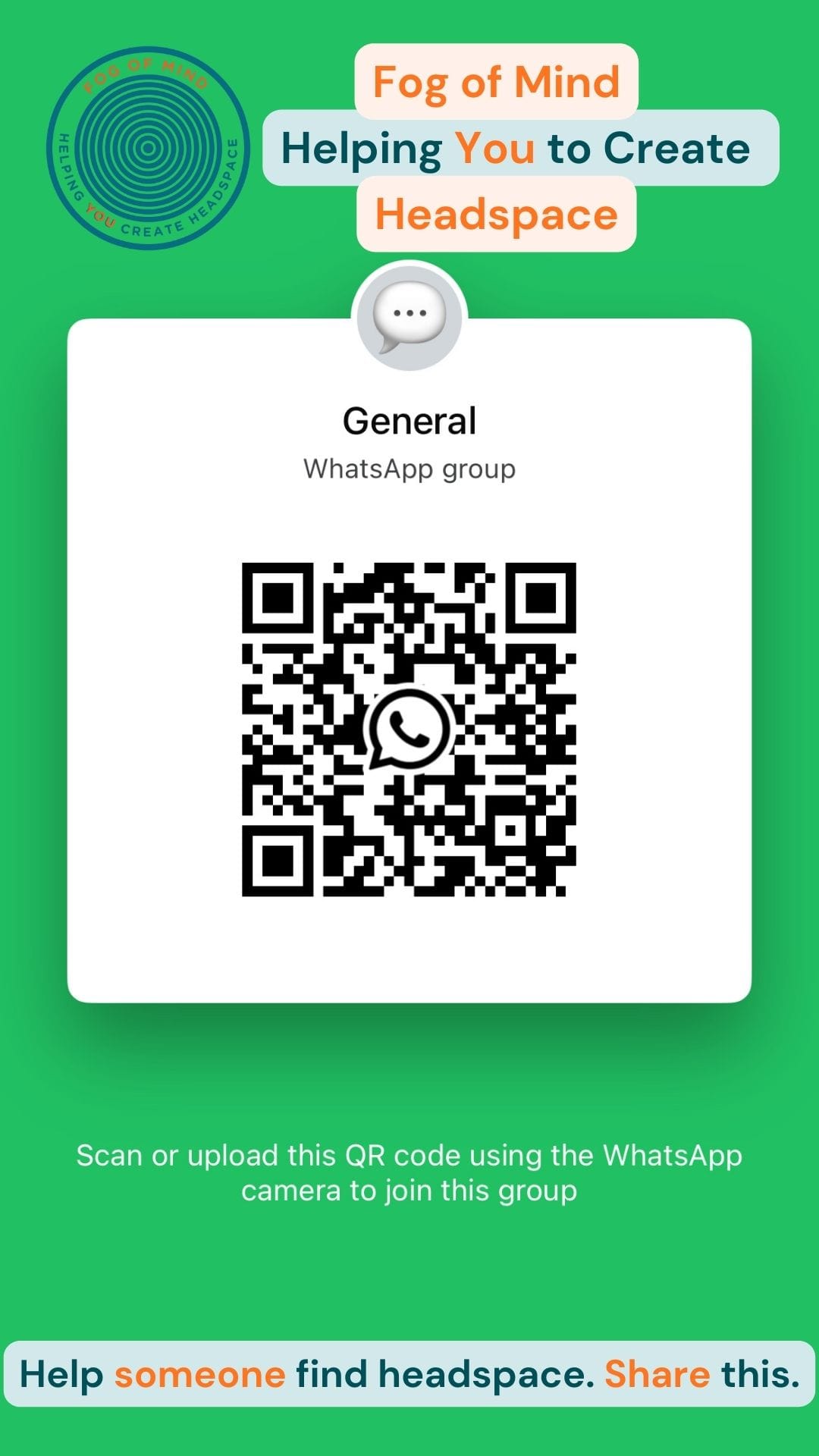
If you want support with this join the Fog of Mind Community
Fog of Mind exists because a lot of people don’t need grand speeches. They need a calm conversation, a fresh perspective, and a practical way to reduce the mental noise.
If you want a 1:1 headspace chat or you’re interested in a talk or workshop for your team, reply or reach out through Fog of Mind. Simple, human, no judgement, and focused on what helps.
Help someone find headspace. Share this.
Sign up and check your spam folder.